Thursday, October 12, 2023

Bullets Go Through Things

Bullets go through things—a rather genius observation; however, sometimes a handgun bullet’s penetrating ability is surprising. During a confrontation between an individual having a mental crisis and Bexar County Sheriff’s Office (BCSO) deputy sheriffs, the deputies fired numerous rounds which penetrated multiple sheetrock walls and metal garage doors. 

A number of years ago an individual who worked for me at that time suffered a mental crisis. He threatened suicide and was preventing his family from leaving their home. BCSO deputy sheriffs responded to a 911 call and the individual hid in a bedroom closet with a shotgun. When the deputies tried to get him to come out and drop the shotgun, he pointed it at the deputies who opened fire with their handguns.

The back wall of the bedroom closet where the individual was hiding was adjacent to the laundry room. The laundry room’s wall was adjacent to the resident’s garage (see diagram).


Reportedly the deputies fired over twenty rounds, three of which struck the individual in the lower abdomen, groin, and leg--he survived the shooting. 

Several of the deputies’ rounds penetrated into the laundry room and struck appliances. At least nine of the deputies’ bullets penetrated the closet and laundry room sheetrock walls and three fully penetrated the resident’s garage door (see picture #1 below). 

Two of these traveled across the street and penetrated a neighbor’s garage door and one of these penetrated the sheetrock wall in the back of the neighbor’s garage. (see pictures #2 & 3 below). These bullets clearly possessed sufficient mass and energy to cause serious bodily harm or death even after they had penetrated two sheetrock walls and two metal garage doors.

Jeff Cooper’s forth rule of firearms safety is “Know your target and what is beyond it.” This incident certainly brings this point home given the penetration of the 9mm rounds the deputy sheriffs fired.* Since many/most people use a firearm for home defense, understanding engagement angles is very important. A safe assumption would be that any round you fire will penetrate at least two interior walls—perhaps more. This may apply to certain exterior walls as well depending upon the home’s construction. In 2021 a Texas woman fired a rifle through the wall of her home, killing a man who had allegedly been peeping into her window.

Residential sheetrock interior walls are little impediment to most handgun, shotgun, and rifle rounds assuming that the rounds do not strike studs or other items in the wall. It seems that residential metal garage doors and some exterior walls are little better.

If you enjoy reading these please follow. The link is on the upper right side of the page.

* I have been told that the BCSO uses Speer Law Enforcement 124 grain +P Gold Dot; however, I have not been able directly confirmed this. I welcome correction.

Friday, September 29, 2023

Texas Commission on Law Enforcement Firearms Instructor Certification

I recently completed the Texas Commission on Law Enforcement (TCOLE) Firearms Instructor Certification. Eric Wise of Cornerstone Performance taught the class. Attending the class were three Austin Police Officers, an officer from the Bryan Texas Police Department (PD) tactical team, a Deputy Sheriff from Bandera Texas, a retired Homeland Security investigations Special Agent, Karl Rehn from KR Training, and me. It was a great class with learning all around.

The TCOLE Firearms Instructor Course requires students to shoot two courses of fire (handgun and shotgun) on the first day of the class with a minimum score of 90%. The handgun course of fire is 50 rounds on a TQ-19 target or equivalent from 25 - 3 yards with a possible score of 250 points. The shotgun course of fire is shot at 25, 15 and 10 yards with five slugs and five buckshot rounds. Any student who cannot achieve 90% or better on both is dismissed and cannot participate in the class.

I was familiar with the TCOLE qualification course since I use it in a number of my intermediate daylight and low light classes. The difference is that for local students in my classes I use a target that matches the city or county where the student lives. These targets are typically the San Antonio PD or the Austin PD targets which have a smaller scoring area than the fairly generous TQ-19 target. I scored a 100% or 250 on the handgun and the shotgun qualifications on the TQ-19.

The other students did very well also with a class average of 248.6 points on the handgun qualification. Out of the six law enforcement officers, four scored 250 on the handgun qualification, one scored a 245, and one scored a 244. Karl Rehn of KR Training scored a 250 as expected.

As the class progressed, it was apparent that every student was a very good shot. All of the students were shooting at the IDPA Master or USPSA A class or better. Our instructor Eric Wise, is a USPSA (Limited and Production) Master, an IDPA Master (Carry Optics Division), and a multiple division Grand Master in Steel Challenge. Eric’s shooting demonstrations reflected this skill level.

The TCOLE Handgun Qualification is as follows:

From the 25 yard line:

-- Starting with the pistol holstered, at the start signal draw and fire two shots in five seconds. You do this four times for a total of eight shots.

-- Starting with the pistol holstered, at the start signal draw and fire six shots in 20 seconds. You do this one time for a total of six shots.

From the fifteen yard line:

-- Starting with the pistol holstered, at the start signal draw and fire two shots in four seconds. You do this one time for a total of two shots.

-- Starting with the pistol at ready, at the start signal draw and fire two shots in four seconds. You do this five times for a total of ten shots.

From the seven yard line:

-- Starting with the pistol holstered with six rounds in the pistol, at the start signal draw and fire twelve shots in twenty seconds.

There is a timed reload on this stage.

From the three yard line:

-- Starting with the pistol holstered, hands at sides, at the start signal draw and fire six shots in twelve seconds using primary hand only.

* Safely transfer the pistol to the support hand.

-- Starting with the pistol in the support hand at the ready, at the start signal fire six shots in twelve seconds using support hand only.

Training days two – four were focused on shooting skill drills and learning the live fire material. On day four all of the students conducted “teach-backs” on our assigned live fire topics with the instructor Eric Wise. On training day five the students taught the live fire curriculum to an open enrollment class of students from the Austin, Bryan, and College Station areas.

The student skill level for this class varied from fairly good to brand new shooters who had no formal training. Each of the instructor-students taught their assigned training module to the class and then conducted live fire drills to practice the skill—all of the students showed significant improvement.

If you have the opportunity to take a class from Eric Wise, I would highly recommend him. Eric is a professional and competent instructor who knows his material and presents it in an easily-understood format. His company is Cornerstone Performance.

I take my instructor continuing education seriously and I typically attend 3-5 classes per year. Eric’s TCOLE class was my seventh class for this year. I have attended enough training that I consider a class a success if I walk away with three or four new teaching tidbits or skills. I walked away from Eric’s TCOLE Firearms Instructor class with an unusually large number of new ideas and/or approaches to teaching the handgun—a very satisfied student.

If you enjoy reading these please subscribe. The link is on the upper right side of the page. All that will happen is that you will receive an e-mail when I post an article. Your information will never be distributed.


Wednesday, September 27, 2023

Training Ammunition - One of Reloading's Benefits

As I was preparing for a Texas Commission on Law Enforcement (TCOLE) Firearms Instructor Certification class I wanted to confirm the zero on my pistols with the training ammunition I planned to use in the class. I zero my SIG P320 and P365 everyday carry pistols for my carry ammunition, the Hornady Critical Duty 9mm 135 grain FlexLock standard pressure round. However, I wanted to determine where the training ammunition was hitting with my carry zero.

Many years ago I developed a 135 grain training load that shot close to the same point of impact as the Hornady Critical Duty. I load the Xtreme 135 9mm 135 flat point plated bullet; Winchester primers; 3.7 grains of Universal Powder; and typically do not sort my brass. I have found that this load has worked well in my SIG P320 and P365.

Being able to match your reloads to your carry ammunition is one of several advantages reloading offers. Reloading can be very satisfying and can save you money as well. Of course, safety protocols are always important to consider and follow. If you are completely new to reloading, there are a variety of books and online information that can help you get started. Click here for an article that discusses some reloading tips and tricks I've learned over the years through my own experience and that of others.

My training load continued to perform satisfactorily with a 15-yard zero within a 1.697-inch circle if I discount the single flyer (that I called). The same held true with the Hornady Critical Duty 9mm 135 grain FlexLock standard pressure round that was also within the 1.697-inch circle discounting the single flyer.


I have always had good results from the Critical Duty standard pressure round in every pistol in which I have tried it. In my pistols, the standard pressure round is typically a little more accurate than the +P version. The fact that the FBI, the Texas Department of Public Safety (state police), and my county sheriff’s office also use the Hornady Critical Duty is a happy coincidence. For several reasons, it is a good idea to carry the round a national law enforcement agency or your state or local police carry, if possible.

Carry ammo is expensive. Reloading your ammunition can provide a more economical practice round for matches and training. The opportunity to develop a load that matches the point of impact for your carry ammunition is an added plus.

If you enjoy reading these please follow. The link is on the upper right side of the page. All that will happen is that you will receive an e-mail when I post an article. Your information will never be distributed. 

Thursday, September 7, 2023

Quit Blowing Up Your Pistols

Quit Blowing Up Your Pistols

In yet another example of how to blow up your pistol, a competitor in a recent pistol match very forcefully hit the back of his pistol’s slide with his left palm in an attempt to clear the malfunction. As he struck the slide, the round detonated in the ejection port.  

At one point, hitting the back of the slide was a commonly taught response to a 1911 pistol failing to go into battery. However as we see in this incident, that may not be a very good idea and indeed could be very dangerous.

The competitor was recording a video of his match so we had the ability to analyze what happened. In picture #1, you can see that there is no round in the chamber. In picture #2 you can see that a round has “nose-dived” into the magazine and was likely holding the slide to the rear. In the video, you can see the competitor pull the slide to the rear to attempt to clear the malfunction which seems to exacerbate the problem because the slide ends up stuck further to the rear.

In picture #3 you can see the competitor’s hand an instant before he slams the slide forward. Note the slide’s position in relation to the muzzle. In picture #4 we see the instant the round detonated in the ejection port—note the slide’s position. The competitor hit the slide so hard he easily forced it forward an inch or more. The competitor received relatively minor cuts since his hand was not directly over the ejection port. The pistol was not seriously damaged, but the magazine was ruined.

So what caused the round to detonate? Before everyone starts—NO, it was not the ejector. The arrow in picture #5 shows the part of the slide which strips a round from the magazine and inserts it in the chamber when the slide moves forward ( I do not know what this part is called and could not find any info identifying the part). When the round nose-dived into the magazine, it perfectly positioned the primer in the path of the slide. Picture #6 shows the detonated round’s primer. Picture #7 shows that the primer fits perfectly into this part of the slide.

As I researched this article, some additional information became available. Earlier in the video the competitor was having feeding problems with his pistol. He mentioned that he had recently replaced the magazine base pads with “+4” extensions without replacing the magazine springs. This coupled with the fact that the magazines were not new may have contributed to the feeding problems and the nose-dive. If you are going to change or add anything to your pistol that takes it out of factory specifications, make sure that the change works.

In my classes I teach that the proper response to a click instead of a bang is to tap the magazine (to ensure it is properly seated) and rack the slide—tap, rack. This will often clear the malfunction. If it does not, the proper response is to lock the slide back, aggressively strip the magazine out, and then reload the pistol and continue to fire if the circumstances so warrant. With the proliferation of striker fired pistols, beating the back of the slide is an outdated technique that is counterproductive.

After reloading, if it does not fire you probably have a broken pistol that's not going to be easily fixed on the spot. If you are under assault, the proper response at that point is to aggressively depart the area or take other necessary action.

Finally, when serving as a match Safety Officer, I have become more aggressive with stopping a shooter when I see them excessively struggling with a malfunction.  This is the fifth incident of this nature that I have direct knowledge of over the past ten years in the San Antonio area. I doubt that it is only happening here. I have noticed that as competitors begin to struggle, the chances of them doing something unsafe rises quickly. These are matches, not life or death situations. If a competitor is having problems we are better off stopping them and allowing them safely resolve the problem and then to reshoot (if necessary) before we permit something unsafe.

If you enjoy reading these posts, please subscribe. The link is on the upper right side of the page. All that will happen is that you will receive an e-mail when I post an article. Your information will never be distributed.

Saturday, September 2, 2023

The Federal Air Marshall TPC revisited using the FBI QIT-97 Target

This is an update of an article I wrote in 2018 that described what I was able to glean concerning the pre 9/11 Federal Air Marshall (FAM) qualification or Tactical Pistol Course (as it was known at that time). From 2016 – 2018 despite numerous tries, I could not pass the TPC even though I was shooting at an IDPA Master level on the old 90 round qualification. I essentially stopped trying.

Fast forward to 2023 and Duane Thomas’ article in the Dillon “Blue Press” on the FAM TPC using the FBI Q target (The Blue Press, June 2023, pages 60-63). Coincidentally, a friend’s daughter is interested in becoming a FAM and asked me to teach a basic pistol class for her and another student. Since I was satisfied that I could pass the TPC using the FBI Q target, I dug out some FBI QIT-97 targets so I could demonstrate the pre 9/11 TPC using that target. I shot it cold and passed the time requirements (barely) and the points.

I shot the qualification with my P320 Carry in 9mm with a Holosun green dot optic sight. I used an open front concealment garment for the strings that required concealment. I was somewhat concerned that the accuracy necessary for success on the QIT-97 would require a bit more deliberation and therefore a quicker concealed draw than the FBI Q target—this proved to be the case.

Target Placement: Two targets placed three yards apart from edge to edge with a third target placed in the middle. Targets are seven yards from the firing line.

Scoring: The maximum possible score is 150 points with a minimum passing score of 135 points. Hits earn five points for inner bottle, 2 points for line hits on inner bottle or full value hits on outer bottle. Zero points for line hits on outer bottle or for a miss. You must be within the time limits for each string of fire. 

Shooting the FAM qualification course within the time limits while hitting the inner bottle necessarily requires a careful balance between speed and accuracy. This is not trivial. If you do not meet every stage’s time requirements, you fail even if you managed to shoot a passing score overall.

The Qualification:

Stage 1: From concealment, draw and fire one round on one target. Repeat. Maximum time is 3.30 seconds for 2 rounds fired.

Stage 2: From low ready, double tap (two shots) on one target. Repeat. Maximum time is 2.70 seconds for 4 rounds fired.

Stage 3: From low ready, fire 6 rounds into one target. Maximum time is 3.00 seconds for 6 rounds fired and all splits (shot to shot time) must be 0.60 seconds or less.

Stage 4: From low ready, fire one shot, reload, fire one shot into one target. Repeat. Maximum time is 6.50 seconds for 4 rounds fired.

Stage 5: From low ready, fire one round into the one of the two outer targets and then transition and fire a round into the other outer target. Repeat. Maximum time is 3.30 seconds for 4 rounds fired.

Stage 6: From concealment and facing up range with back to targets, turn 180 degrees and place one shot into each of the three targets. Repeat. Maximum time is 7.00 seconds for 6 rounds fired.

Stage 7: From low ready and standing, fire one round into one target, slide locks back, drop to one knee, reload, fire one round. Repeat. Maximum time is 8.00 seconds for 4 rounds fired. (Note this is essentially a slide lock 1-reload-1 drill just dropping to a knee while reloading)


The times for the qualification shown in the picture above using my P320 Carry were as follows:

Stage 1: Draw: 1.56, 1.57 = 3.13 (Standard: 3.30 seconds or less)

Stage 2: Double Tap: 1.06, 1.03 = 2.09 (Standard: 2.70 seconds or less)

Stage 3: Rapid Fire: 2.84 (Standard: 3.30 seconds or less)

Stage 4: Speedload: 3.26, 3.34 = 6.50 (Standard: 6.50 seconds or less) I barely squeaked by on this stage.

Stage 5: Transition: 1.55, 1.49 = 3.04 (Standard: 3.30 seconds or less)

Stage 6: Turn & Draw, 3 Targets: 3.04, 3.07 = 6.11 (Standard: 7.00 seconds or less)

Stage 7: Slidelock Reload: 3.10, 3.98 = 7.08 (Standard: 8.00 seconds or less)

Times = Pass for all strings

Points = Passed with 138 points (I dropped a total of four shots (or twelve points) outside the inner bottle)

The Federal Air Marshall TPC is an extremely challenging pistol qualification and particularly challenging using the QIT-97 target.

If you enjoy reading these please subscribe. The link is on the upper right side of the page. All that will happen is that you will receive an e-mail when I post an article. Your information will never be distributed.

Monday, August 28, 2023

Shooting the Pre 9/11 Federal Air Marshall's Qualification Course or TPC

Recently Dillon Precision’s “Blue Press” published a Duane Thomas article concerning the pre 9/11 Federal Air Marshall (FAM) qualification course.* This article, in conjunction with a close friend’s daughter expressing an interest in becoming a FAM rekindled my interest in the earlier FAM qualification. (*The Blue Press, June 2023, pages 60-63). 

I was talking about the qualification with a shooting partner when he mentioned that a mutual friend had been a FAM. Since our mutual friend had retired as a Special Agent (SA) from another federal agency, it never occurred to me to ask about the FAM qualification. I will refer to my friend as Special Agent (retired) or SA ret. for the remainder of the article.

SA ret. confirmed all of the FAM scoring, target positioning, etc. that Thomas mentioned in the Blue Press article. Since SA ret. was a firearms instructor at his agency, he had been detailed to the FAM program literally the week after 9/11 as the government scrambled to increase the number of FAMs in the program. My friend said that since they were all credentialed LEOs or Special Agents, the detailees were put through an intensive firearms training program to ensure that their shooting skills were up to FAM standards. SA ret. said that they shot all day, every day for two weeks. He said that they literally shot so much that at the end of the training the FAM program replaced all of their issued pistols because they had exceeded the pistol’s service life.

I had written an article in 2018 that described what I was able to glean concerning the pre 9/11 from research and a discussion with Mike Seeklander at the 2016 IDPA Nationals. Mike Seeklander indicated that the FAM had used an FBI QIT-97 Target and a scoring system that differed from that which Thomas mentioned in his article which was the FBI-Q (milk bottle) target. As Thomas mentioned, the FAM program has likely used a number of qualification courses and targets over the years; therefore, the discrepancy between what Thomas mentions as the standard target and the QIT-97 Seeklander mentions are probably a result of different time frames.

Scoring: The maximum possible score is 150 points with a minimum passing score of 135 points. A minimum passing score of 135 allows for three complete misses. From my experience, if you are at the level where you routinely miss the FBI Q entirely your chances of passing the qualification are slim.

You must be within the time limits for each string of fire. Shooting the FAM qualification course within the time limits while hitting the bottle necessarily requires a balance between speed and accuracy because of its strict adherence to the maximum time requirements for each stage. This is not trivial. If you do not meet the stage’s time requirement, you fail even if you managed to shoot a passing score overall.

Shooting the FAM qualification course is best done on an outdoor range. The course requires you to shoot targets spaced across lanes and one of the stages requires the shooter to turn 180-degrees without sweeping anyone. You must use a concealment garment for two of the seven stages.

The course of fire is 30 rounds from 7-yards, fired at three targets spaced three yards apart. Per Thomas: “The FAM set up the outer two targets with three yards – nine feet – between them edge-to-edge, then centered a third target between those. When you do it that way, according to my tape measure the distance between targets edge-to-edge is three feet, six and a half inches.” Some INTERNET sources claim the targets were three yards apart. Thomas goes on to state that given the FAM program’s mission, the nine feet distance makes sense. No commercial aircraft was wide enough for three people to stand eighteen feet apart in a fuselage.

The Target: Thomas mentions that the pre 9/11 FAM qualification used the standard FBI-Q target scored as five points for a full value hit within the bottle and zero points for hits outside the bottle. In other words, a hit on the line of the silhouette scores as a miss. SA ret. told me that in the FAM program he attended they used a version of the FBI-Q target that had a circle in the upper chest; however, they ignored the circle for scoring and used the entire bottle with full value scoring.

The Qualification:

Stage 1: From concealment, draw and fire one round on one target. Repeat. Maximum time is 3.30 seconds for 2 rounds fired.

Stage 2: From low ready, double tap (two shots) on one target. Repeat. Maximum time is 2.70 seconds for 4 rounds fired.

Stage 3: From low ready, fire 6 rounds into one target. Maximum time is 3.00 seconds for 6 rounds fired and all splits (shot to shot time) must be 0.60 seconds or less.

Stage 4: From low ready, fire one shot, reload, fire one shot into one target. Repeat. Maximum time is 6.50 seconds for 4 rounds fired.

Stage 5: From low ready, fire one round into the one of the two outer targets and then transition and fire a round into the other outer target. Repeat. Maximum time is 3.30 seconds for 4 rounds fired.

Stage 6: From concealment and facing up range with back to targets, turn 180 degrees and place one shot into each of the three targets. Repeat. Maximum time is 7.00 seconds for 6 rounds fired.

Stage 7: From low ready and standing, fire one round into one target, slide locks back, drop to one knee, reload, fire one round. Repeat. Maximum time is 8.00 seconds for 4 rounds fired. (Note this is essentially a slide lock 1-reload-1 drill just dropping to a knee while reloading).

My friend and I shot the FAM qualification during a training session in August 2023. The temperature on the range was 102 degrees with no shade so the heat challenged us a bit. We used the Range Master Q target which is similar to the to the FBI Q Target (with additional circles inside the bottle and a line at the bottom). We used the middle target for most strings which resulted in a possible hit count of 22 hits on the middle target and four hits each on the outer targets.

I shot the qualification with my every day carry (EDC) P320 Carry in 9mm and my alternate P365 in 9mm. Both have Holosun green dot optic sights. I used a closed front t-shirt as my concealment garment for the strings that required concealment.

I completed two qualifications with my P320, the first shot cold, and passed both. 
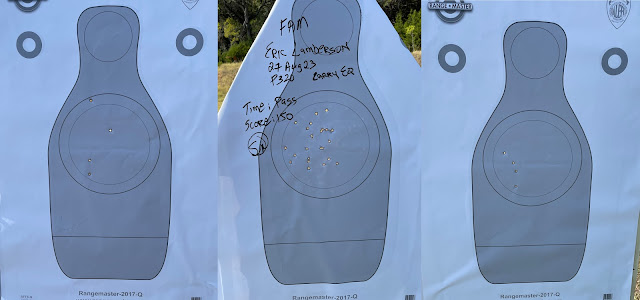
 

FAM Qualification with the P320

FAM Qualification with P320

The times for the qualification shown in the picture above using my P320 Carry were as follows:

Stage 1. Draw: 1.48, 1.39 = 2.87 (Standard: 3.30 seconds or less)

Stage 2. Double Tap: .88, 1.08 = 1.96 (Standard: 2.70 seconds or less)

Stage 3. Rapid Fire: 2.20 (Standard: 3.30 seconds or less)

Stage 4. Speedload: 3.06, 2.95 = 6.01 (Standard: 6.50 seconds or less)

Stage 5. Transition: 1.32, 1.28 = 2.60 (Standard: 3.30 seconds or less)

Stage 6. Turn & Draw, 3 Targets: 2.69, 2.71 = 5.30 (Standard: 7.00 seconds or less)

Stage 7. Slidelock Reload: 3.54, 3.79 = 6.53 (Standard: 8.00 seconds or less)

Times = Pass for all strings

Points = Passed with 150 points


FAM Qualification with the P365

I completed three qualifications with my P365 and passed all three. The times for the qualification shown in the picture above using my P365 were as follows:

Stage 1. Draw: 1.62, 1.52 = 3.14 (Standard: 3.30 seconds or less)

Stage 2. Double Tap: 1.15, 1.06 = 2.21 (Standard: 2.70 seconds or less)

Stage 3. Rapid Fire: 2.75 (Standard: 3.30 seconds or less)

Stage 4. Speedload: 3.04, 3.41 = 6.45 – barely squeaked by on this string due to issues with the concealment garment during the reloads (Standard: 6.50 seconds or less)

Stage 5. Transition: 1.37, 1.48 = 2.83 (Standard: 3.30 seconds or less)

Stage 6. Turn & Draw, 3 Targets: 3.22, 3.01 = 6.23 (Standard: 7.00 seconds or less)

Stage 7. Slidelock Reload: 3.80, 3.77 = 7.57 (Standard: 8.00 seconds or less)

Times = Pass for all strings

Points = Passed with 145 points (the shot touching the line on the middle target is a miss).

The FAM Qualification course tests several major tasks you must perform in the course of shooting a match or using a pistol for self-defense. They are:

-- Safely draw the pistol (clear concealment garment)

-- Extend to fire

-- Transition between targets

-- Reload the pistol (clear concealment garment)

-- Execute precise shots (sight alignment, sight picture, trigger control)

-- Turning then drawing the pistol

-- Moving from standing to kneeling

In my series of articles on deliberate practice I discuss the value of structured drills with specific goals designed to improve performance. Each of the major tasks listed above is composed of sub tasks that also must be performed correctly. Once we break each major task down into sub tasks we can then apply the deliberate practice methodology to improve our shooting.

For example: I have been practicing coming on target from a low ready position and firing an accurate shot. My practice has resulted in a .20 to .30 second improvement. When you do this five times during a qualification that time savings adds up.

The Federal Air Marshall course of fire is an extremely challenging pistol qualification and is a good tool for concealed carriers to use to benchmark their skills. If you can stay within the time limits and score a perfect 150, I will tip my hat to you.  

If you enjoy reading these please subscribe. The link is on the upper right side of the page. All that will happen is that you will receive an e-mail when I post an article. Your information will never be distributed.